

Japanese Conversation · Level 45
90 words
Search Japanese words as written, in romaji or by English meaning.
Dictionaries
Quick links
Browse
 MotiSpiOfficial conversation app

Japanese word
Romajimuku
じゃがいもの皮をむきます。ja ga i mo no kawa o mu ki ma su
I peel a potato.
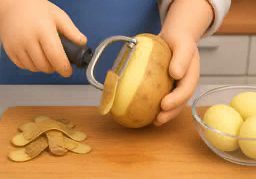
ピーラーでりんごの皮をむきます。pī rā de ri n go no kawa o mu ki ma su
I peel an apple with a peeler.
Describes removing a thin outer layer from something while leaving the main part intact.
野菜の皮をむくya sai no kawa o mu ku
peel a vegetable
剥ぐhagu: To remove a covering or outer layer from something, often in one piece.
剥がすhagasu: To remove something attached to a surface by pulling it away.
そぐsogu: To cut away a thin layer from the surface of something with a knife.
果物や野菜などの表面を覆う皮を取り去る。kudamono ya ya sai na do no hyō men o ō u kawa o to ri sa ru
むく (muku, "to peel") is a native Japanese verb, and its common kanji spelling 剥く (muku, "to strip") reflects the removal of an outer covering.