

German Conversation · Level 11
90 words
Search German words by spelling or English meaning.
Dictionaries
Quick links
Browse
 MotiSpiOfficial conversation app

German word
IPA/ˈhaːzə/
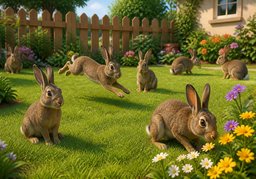
Im Garten sind viele Hasen.
There are many rabbits in the garden.
Ich habe gestern einen Hasen im Park gesehen.
Yesterday, I saw a rabbit in the park.
A long-eared field animal bounds quickly through open land, linking the German word to the familiar English image of a hare.
einen Hasen halten
keep a rabbit
einen Hasen sehen
see a rabbit
Kaninchen: A small rabbit often kept as a household pet.
Feldhase: A larger wild hare that lives in fields and grasslands.
Häschen: An affectionate term for a little rabbit or young bunny.
Ein größeres, wild lebendes Säugetier mit langen Ohren und kräftigen Hinterbeinen, das schnell läuft; Plural: Hasen.
Hase continues an inherited Germanic noun, Old High German haso, related to English hare and traced to reconstructed Proto-Germanic *hasô.