

German Conversation · Level 12
90 words
Search German words by spelling or English meaning.
Dictionaries
Quick links
Browse
 MotiSpiOfficial conversation app

German word
IPA/ˈeːzl̩/
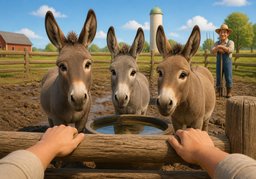
Auf dem Bauernhof sehe ich die Esel.
At the farm, I see the donkeys.
Er benahm sich wie ein Esel und weigerte sich zu helfen.
He behaved like a donkey and refused to help.
A long-eared pack animal plods steadily under a load, while the same image can describe a foolish or stubborn person.
jemanden zum Esel machen
make a fool of someone
stur wie ein Esel
as stubborn as a donkey
auf den Esel steigen
get on the donkey
Maulesel: An animal born from a horse and a donkey, used especially for hauling loads.
Lastesel: A donkey used for carrying especially heavy loads.
Packtier: A broad term for an animal used to transport loads on its back.
Pferd: A large, fast-running farm animal kept for riding and work.
Ein domestiziertes, robustes Huftier mit langen Ohren, meist ruhiges und zähes Arbeitstier, das Lasten trägt und auf Bauernhöfen gehalten wird.
German Esel goes back through Old High German esil to Latin asinus and is related to English ass.